Harry Sinclair
Killers of the Flower MoonHarry Sinclair emerges as one of the oil magnates who gathered in Pawhuska to compete for Osage leases and wield influence far beyond the auction ground. He bought a lease for more than $600,000, helped finance Warren Harding’s successful presidential bid alongside other oilmen, and received an exclusive lease to the Wyoming reserve known as Teapot Dome. His story links the visible spectacle of petroleum wealth to the political arrangements that helped the magnates secure access to oil.
Identity and Position
Sinclair appears in the book not through a personal biography but through the institutions and contests that made him powerful: the Osage lease auctions and the national politics surrounding oil. He belonged to a group of barons whose wealth and influence, the account suggests, rivaled or exceeded that of earlier railroad and steel magnates. Their reach was tangible in Pawhuska, where they arrived in luxurious private railcars and competed for drilling rights on land whose mineral wealth belonged to the Osage.
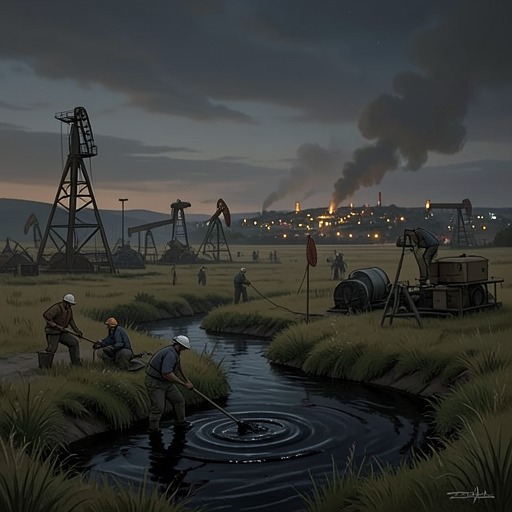
The scale of the petroleum rush was visible in the landscape as well as in Sinclair’s purchases. In 1917, a well on Lot 185 erupted in a towering black column of oil; three years later, E. W. Marland’s Burbank field produced a new well that yielded 680 barrels in its first twenty-four hours. These discoveries helped make the lease auctions a high-stakes contest. Sinclair’s significance in the narrative rests on his position among those who could turn that contest into immense private opportunity.
The Osage Lease Auctions
The United States Department of the Interior oversaw auctions held about four times a year. Since bidding began in 1912, only part of the underground reservation had been opened to drilling, while a typical lease—often covering 160 acres—could command rapidly rising bids. The auctions drew Sinclair and other oilmen to Pawhuska every three months, at ten in the morning, in a procession of luxurious railcars that local newspapers heralded as the arrival of millionaires.
In good weather, bidding took place outdoors on a Pawhuska hilltop beneath the Million Dollar Elm tree, with spectators arriving from miles away. In winter, the January 18, 1923, auction was held inside the Pawhuska Constantine Theater, a building decorated with Greek columns, murals, and lights around its stage. Sinclair’s participation was not merely ceremonial: that day, Tract 13 sold to him for more than $600,000. The next tract drew a half-million-dollar bid from a representative of Gypsy Oil Company, showing how the contest could escalate from one expensive purchase to another.
The auctions were also arenas of information and risk. Oilmen studied geological maps and relied on employees known as rock hounds and spies to learn about the leases. A lucky purchase could transform a cash-strapped wildcatter into a rich man; a mistaken bid could ruin one. Sinclair’s successful purchase of Tract 13 places him among the bidders able to compete at the uppermost scale, while the crowded theater and soaring prices show how intensely the oil-bearing land was coveted.
Political Influence and Teapot Dome
Sinclair’s auction power coincided with political influence. In 1920, he, E. W. Marland, and other oilmen helped finance Harding’s successful presidential campaign. The account distinguishes this collective effort from a separate estimate by an Oklahoma oilman that Harding’s nomination had cost him and his interests $1 million; it does not assign that particular sum to Sinclair. After Harding entered the White House, oilmen sought access to the Navy’s strategic reserves.
The book connects that effort to illicit payments made to Secretary of the Interior Albert B. Fall. Sinclair funneled more than $200,000 to Fall through the cover of a bogus company. In return, the secretary allowed oil barons to tap the reserves, and Sinclair received an exclusive lease to a Wyoming reserve called Teapot Dome, named for the shape of a nearby sandstone formation. A warning from the head of Standard Oil that the proposed contract smelled bad signals that suspicion circulated within the industry even before the payoffs became public. The passage presents Sinclair’s lease as part of a larger exchange between political access and private gain, not as an isolated auction victory.
Public Prestige and the Book’s Contrast
While the illicit payoffs remained unknown to the public, Sinclair and his fellow magnates were welcomed as princes of capitalism. At the Million Dollar Elm tree, the crowd parted for them as they moved toward the front to bid. The book sets that deference beside the concealed arrangements behind their access to public reserves: the men appeared as celebrated builders of wealth while using political influence to obtain valuable oil leases.
The contrast also sharpens the significance of the Osage auctions themselves. They converted mineral rights into extraordinary bids and drew national oil power into Pawhuska, but the spectacle of competition did not mean that all parties held equal power. Sinclair’s purchase and the Teapot Dome lease show two routes to oil wealth—one through public bidding for Osage leases, the other through a secretive political arrangement over federal reserves. The account establishes his prominence through those concrete transactions, while offering no basis for attributing to him the separate abuses committed by guardians who stole from Osage wards.